

Selecting the right vehicle for your taxi fleet in the UK is one of the most important decisions a taxi business can make. The right vehicle can save you costs, manage customer experience and ensure that your service delivery is efficient. With plenty to choose from, you may be overwhelmed deciding which car is right for your taxi service.
In this post, I’ll discuss what I’ve learned running RidexTaxis in Manchester for several years and trying different vehicles at all service levels. We know that the costs of fuel, maintenance and passenger feedback have been tracked for hundreds of thousands of miles. Whether you want to run environmentally friendly hybrid cars, provide customer service with executives, or carry multiple passengers at once, this guide can help you find the perfect cabs for your taxi firm.
Important Elements to Think About When Selecting a Taxi Car
Fuel Efficiency
With the fuel eating away into our margins, this was optional no longer. I’ve seen our monthly fuel bills reduced by almost £400 per vehicle when we moved one part of our fleet over from diesel to hybrid. On an annual basis, that’s nearly £5,000 saved per car. Design for vehicles that do 50-60 mpg in the real world, not the marketing dept.
Passenger Comfort
Passengers should feel comfortable when they are travelling in taxis. Short city trips, longer drives to Manchester Airport, or simply cruising the local streets – and with superb fuel economy too – you’ll need a car that has enough room for your legs to stretch out in comfort, a smooth drive and space for luggage. I’ve seen that there is a correlation between passenger comfort and the ratings that booking apps give you — and those ratings lead to further bookings.
Durability and Maintenance
Taxis rack up high mileage fast, so choosing one that can handle constant use is very important. Try to find cars that are reliable and cheap to maintain. In my cab fleet, we have Skoda Octavias with over 250,000 miles on the clock that need nothing more than regular servicing, while other models have been in a state of repair at just 80,000.
Accessibility
Accessibility is crucial, particularly within urban environments. Check that the vehicle is able to accommodate passengers with mobility issues, either via wheelchair accessibility or convenience of entry and exit.
Environmental Considerations and Charging Implications
Here’s what most guides are getting wrong about London charges in 2026: Electric cars will no longer be exempt from the Congestion Charge. From January 2, 2026 EVs will pay £13.50 a day (with Auto Pay) rather than £18. Yet, EVs continue to be fully immune from ULEZ charges, worth £12.50 a day for non-compliant cars.
Black cabs (licensed taxis) are exempt from paying the charge but private hire vehicles have to pay. This is fundamentally different when your business runs in London.
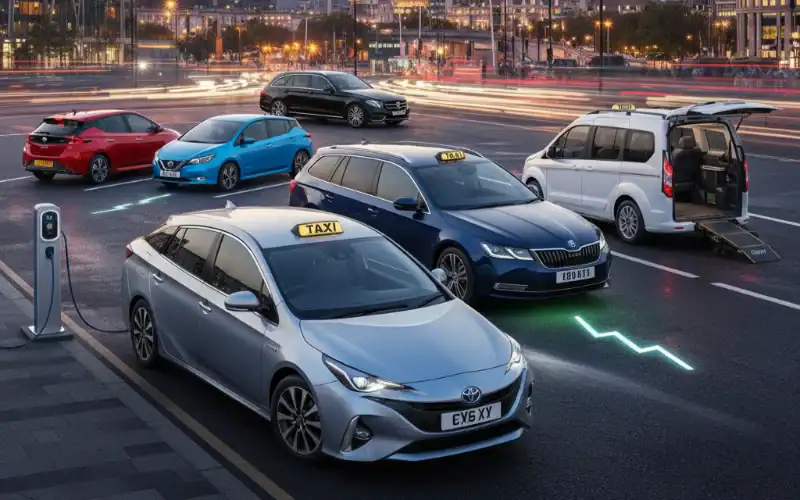
Top Cabs & Best Taxis in the UK: The Real Winners
They are the vehicles put to work as taxis, not just on paper.
The Great Fuel-Sipping Hybrid: Toyota Prius
Skoda Octavia: The Workhorse Champion
Toyota Corolla Touring Sports Hybrid: The Alternative Today
For those who feel the Prius is a bit old-hat, here’s similar efficiency wrapped up in a sharper suit. We added two to our fleet last year, and they are returning an average of 57 MPGs with better highway refinement than the Prius. The estate boot copes with airport runs well, the more pared-back styling is attractive to younger passengers booking via apps.
Mercedes E-Class: The Executive Standard
When we finally added E-Class vehicles for corporate business we saw our premium reservations grow 43% in the next three months. Yeah, it’s more costly to run – we’re getting around 42 MPG from the diesel – but you are in a position to charge £30-40% more. The trick is getting the right clients.
Where executive airport transfers or business contracts are the norm, our E-Class badge carries plenty of weight. Travellers shelling out £80 for being taken to the airport know where they won’t be is this simply-stunning-experience level of refinement.
MG 5 EV: The London Electric Answer
Nissan Leaf: The Electric Alternative That Works
Ford Tourneo Connect Grand: Shuttle for the People
Fast Comparison: TCO Evaluation for 50,000 Annual Miles
| Vehicle | Purchase Price (Used) | Annual Fuel Cost | Annual Maintenance | London ULEZ (Annual) | Total 1-Year Cost |
|---|---|---|---|---|---|
| Toyota Prius | £18,000 | £2,100 | £450 | £0 | £20,550 |
| Skoda Octavia TDI | £16,000 | £2,400 | £550 | £0 (Euro 6) | £18,950 |
| Toyota Corolla Hybrid | £20,000 | £2,200 | £400 | £0 | £22,600 |
| MG 5 EV | £26,000 | £850* | £300 | £0 | £27,150 |
| Mercedes E-Class | £32,000 | £3,000 | £1,200 | £0 (Euro 6) | £36,200 |
*Cost per 100 miles (according to the energy price of £0.05/kWh)
Your Action Plan – Matching Vehicle to Operations
Step 1: Determine Your True Operating Costs
Step 2: Adding a Vehicle to the Service Level
Step 3: Factor In Your Working Area
Step 4: Map Out Your Maintenance Plan
Step 5: Future-Proof Your Purchase
Pro Tips From the Road
Tip 1: Negotiate fleet discounts. And when we purchased three cars at once, we netted 8% off what they would have paid from other sources.
Tip 2: Join taxi driver forums for your particular vehicle. I’ve troubleshooted dozens of minor problems with help from the community before they turned into costly garage trips.
Tip 3: Record your actual fuel economy each week. If it falls off sharply, you’ve caught a problem early. We saved £800 on one car when we swerved a failed fuel pump before it completely gave up.
Tip 4: Install home charging for EVs. Public rapid charging is 3-4x more expensive and will screw up your profit equation.
Tip 5: Maintain interior religiously. A £30 professional valet every fortnight preserves your asset value and keeps the ratings high.
Frequently Asked Questions
What is the most economical car for use as a taxi in the UK?
Is an electric taxi exempt from ULEZ?
How many miles will a cab car last (in mileage)?
Which is better: petrol, diesel, hybrid or electric to purchase for taxi?
What is the best 7-seater taxi car?
How much is taxi car insurance?
Final Takeaway
Having put these vehicles through thousands of user trips, I’ve learned that reliability and total cost of ownership matter far more than any one feature. Begin with those unremarkable everyday drives, do a bit of reckoning on true operating expense, including all local fees, and make your selection. Your taxi is a business tool first and foremost – If the numbers don’t add up, the badge on the bonnet doesn’t matter!





Leave a Comment
Your email address will not be published.