
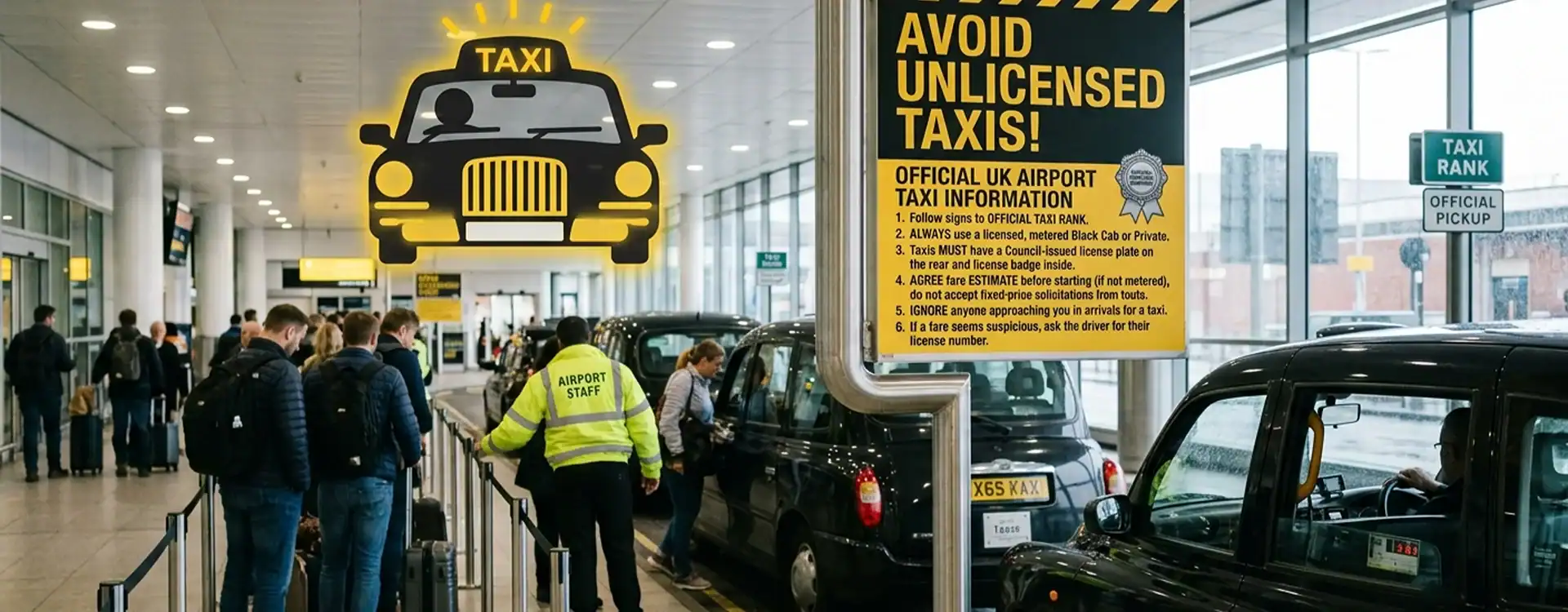
Airport taxi scams in the UK follow a few predictable patterns. Almost all start within two minutes of you entering arrivals. Someone approaches you before you reach the rank. Or the meter suddenly stops working. Or the price you agreed online is not the price asked at the kerb.
This guide covers the five scams that actually turn up at UK airports, how to check that a taxi or private hire vehicle is properly licensed, what to do if a driver demands more than the quoted fare, and where to report it afterwards. The table below is the short version if you are reading this while waiting for a bag.
Quick Answer
| Scam Type | Where It Happens | How to Avoid It |
|---|---|---|
| Unlicensed touts | Terminal arrivals hall | Ignore anyone who approaches you inside the terminal. Use the official rank or your pre-booked meeting point. |
| “Broken” meter | Inside the vehicle | Take a metered taxi from the official rank, or pre-book a private hire car with a written quote. |
| Route padding | En route | Follow the route on your phone map. A fixed price booking removes most of the incentive. |
| Card machine “fault” | On arrival at the destination | Agree the fare and the payment method before you set off. |
| Fake booking sites | Online, before travel | Book through the operator’s own website or a phone number you have checked yourself. |
Airport taxi scams cost UK travellers money, and occasionally they put people in a car they should never have got into. The usual tricks are unlicensed drivers touting for business inside the terminal, meters that suddenly stop working, and quoted prices that climb once the car is moving.
Why This Still Happens in 2026
Airports suit this kind of thing. Passengers are tired, the surroundings are unfamiliar, and most people just want to get moving. Major UK airports have official ranks and licensing rules. Yet touts still work in the arrivals hall. This happens most late at night. Legitimate queues are long then. There are also fewer staff around.
It helps to know the difference between the two types of vehicle. A hackney carriage, the black cab style licensed taxi, can be hailed or picked up from a rank and normally runs on a meter. A private hire vehicle has to be booked in advance through a licensed operator and cannot legally be flagged down or accept a walk up fare in the terminal. So when someone approaches you on foot offering an immediate ride, that offer is already outside the rules, whatever they say they are driving.
The problem is rarely that people do not know this. It is the moment at the end of a long flight when a stranger says he will sort you a car right now, and you are too tired to ask a single question.
The Five Scams to Know
- The terminal tout. Someone intercepts you before you reach the rank, offers a good price, and walks you to an unmarked car parked outside the licensed area. Because the journey was never booked through a licensed operator, the driver’s insurance may not be valid for hire and reward, which means you may not be covered in the way you would be in a properly licensed vehicle. There is also no operator record of the trip if something goes wrong.
- The broken meter. The driver has a metered vehicle but says the meter is out of order and asks for a flat cash figure well above the normal fare. This is more common with opportunist drivers than with established operators, since a firm that quotes a fixed price up front has already removed the argument.
- Route padding. The driver takes a longer way round, either through genuine unfamiliarity or on purpose, and a metered fare climbs accordingly. A pre-booked fixed price journey largely removes the incentive, although it is still worth keeping your map open so you know roughly where you are going.
- The card machine that will not work. You arrive, the terminal is suddenly faulty, and the driver pushes you towards a cash figure higher than the one you expected. Confirm both the price and the payment method before the journey starts rather than at the kerb.
- Fake booking sites and apps. Search results and app stores carry pages that copy genuine operators, take a payment in advance, and then no car turns up. Use the operator’s official website or a phone number you have verified yourself, and be wary of a site you reached through an ad that looks slightly off.
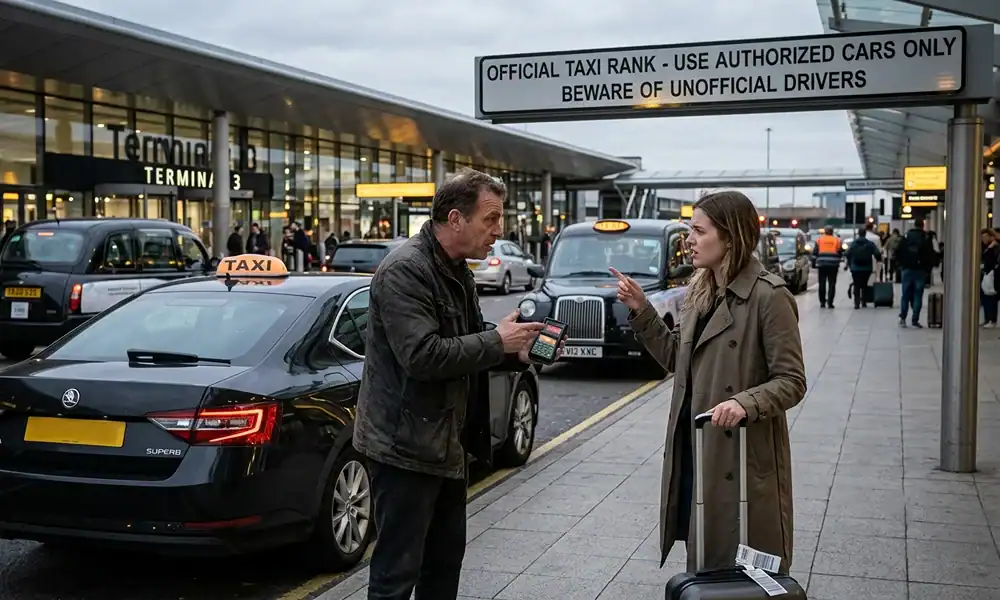
4-Step Checklist on How to Book Safely
Step 1: Book before you fly. Arrange your transfer at least 24 hours ahead through a licensed private hire operator’s website or booking line. That way the price is agreed and the driver is assigned before you land, so there is nothing to negotiate in the arrivals hall.
Step 2: Check the licensing. A licensed private hire vehicle will normally display a council issued licence plate or disc, and the driver should carry a photographic ID badge. Exactly where the plate sits and what it looks like varies between licensing authorities, so if you are unsure, ask the driver to show you the badge and confirm your name, destination and booking reference. If nothing matches, do not get in, however good the offer sounds.
Step 3: Get the fare in writing. The full price should appear in your email or text confirmation. If a driver asks for more than that on the day, you can pay the confirmed amount and take it up with the operator afterwards.
Step 4: Track your driver. Most established operators send driver and vehicle details before pickup, and many offer live tracking. It means you know who is collecting you rather than scanning a line of cars and hoping.
Pro Tips From the Rank
- A fixed price transfer is the single most useful step you can take, because it removes the two things these scams rely on, roadside negotiation and vagueness about the route.
- A legitimate driver already knows your name. If someone asks you who you are waiting for rather than confirming your name from their booking, treat that as a warning sign.
- Flights run late. A licensed operator will usually track your flight and move the pickup automatically, so a delay should not turn into a fresh price discussion at the kerb.
- Screenshot your booking confirmation before you land, in case signal or app access is patchy inside the terminal.
- Touts are most active late at night, which is exactly when a booked transfer is worth the most.
FAQs
How can I tell if an airport taxi is licensed?
Look for a council issued licence plate or disc on the vehicle, usually at the rear, and ask the driver for their photographic ID badge. Requirements differ between licensing authorities, so also check that the driver already has your name, destination and booking reference. A driver who cannot produce any of that is not the driver you booked.
Are airport taxi ranks safe to use?
Official ranks and marshalled queues are the safest option if you have not booked ahead, because only authorised vehicles should be working them. The risk is usually not the rank itself, it is being intercepted before you reach it.
Pre-book or hail on arrival, which one is cheaper?
Pre-booking is more predictable rather than automatically cheaper. You know the fare before you travel and there is no exposure to route padding or a meter that stops working. On short journeys a metered taxi from the rank can work out similar or less, so compare the quote against the likely meter fare for your route.
What should I do if the driver asks for more than the quoted price?
Politely decline and pay the amount you confirmed. Keep the booking confirmation, note the vehicle registration and licence plate number, and report it to the operator first. If that gets you nowhere, report it to the licensing authority that issued the driver’s licence, which you can find through GOV.UK’s local council finder, and to the airport’s customer services team. Call 101 if you feel threatened or believe an unlicensed vehicle was involved, and report a fake booking website to Action Fraud.
Is it safe to pay by card in a UK taxi?
Yes, with a licensed operator. Confirm the payment method and the total when you book, so there is nothing to argue about when you arrive.
Do unlicensed taxis have insurance?
Carrying passengers for payment requires hire and reward insurance, and a driver operating without the right licence often does not hold valid cover for it. An insurer may also treat the policy as void once it becomes clear the vehicle was being used illegally. In short, you cannot rely on being covered the way you would be in a properly licensed taxi or private hire vehicle.
What to Do Next
If you pre-book your next Manchester Airport transfer with Ridex Taxis rather than hailing something on arrival, you have a fixed price and a named driver before you land, which takes most of the scenarios above off the table. If you are looking at a specific route, our Manchester to Luton Airport taxi page covers journey times and pricing in full. And if your bags do not appear on the carousel, our guide to lost luggage at Manchester Airport explains what to do next.



Leave a Comment
Your email address will not be published.