
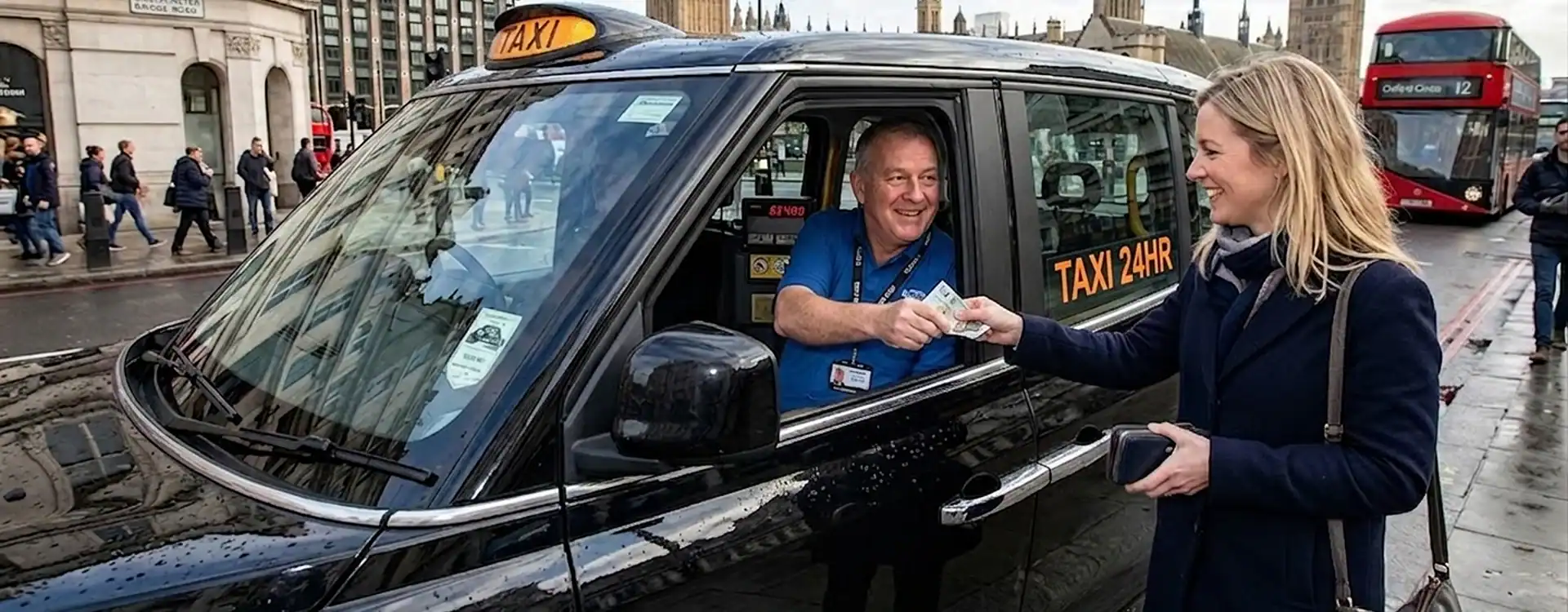
No, you do not have to tip a taxi driver in the UK. Unlike the US, where tips make up a large share of a driver’s earnings, UK taxi and private hire fares are intended to be the full payment for the journey. A tip is simply a thank you for good service, not a correction to underpayment. Most passengers either round up to the nearest pound or add up to 10% for standout service. For pre-booked fixed-fare rides such as Ridex airport transfers, drivers rarely expect a tip at all, since the price is agreed upfront and there is no meter running up an expected percentage. Whether you pay by cash or card, tipping remains entirely your choice and never an obligation.
Quick Answer
| Question | Quick Answer |
|---|---|
| Is tipping compulsory in the UK? | No, it’s optional, not compulsory the way it is in the US. |
| Typical amount | Round up the fare, or add 10% for great service. |
| Cash or card? | Both work; card tips are increasingly common via app-based bookings. |
| Airport transfers | A small tip for luggage help or early arrival is appreciated, not expected. |
| Black cabs vs private hire | Black cab tipping is slightly more traditional; minicab/PHV tipping is more casual. |
| Who never expects a tip | Drivers on fixed pre-booked fares (like Ridex airport transfers) rarely expect one. |
In short, no. In the UK, taxi drivers do not expect a tip, but it is a kind gesture. In America, tipping supplements a driver’s basic pay. By contrast, UK fares are set to cover the journey in full: hackney carriage (taxi) fares are capped by a tariff set by the local licensing authority, while private hire fares are set by the operator. Neither includes a gratuity, so anything extra you give is a thank you rather than a correction to underpayment.
Nonetheless, to say these gratuities are “not required” does not mean they’re “never done.” Many passengers round up or add a little for good service. This is what really happens on UK roads, and where the most misunderstandings arise.
Why Tipping Culture in the UK Feels Different
In restaurants, taxis, and hairdressers, British tipping culture generally sits lower than that of the US. When it comes to taxis, most passengers either round up to the nearest pound or wave small change away without counting it back. The most frequent type of “tipping” you’ll see in practice is a fare of £13.40 becoming £14. It’s less about calculating percentages and more about rounding them.
London black cabs have a somewhat older custom of rounding up or adding ten per cent, reflecting a long-established licensed trade whose drivers must pass The Knowledge before being licensed. Tipping for private hire and minicab journeys, including app-booked and pre-booked trips, tends to be more relaxed; many passengers tip nothing at all, and drivers don’t expect it.
A few situations nudge passengers toward tipping, even without any rule saying they should:
- The driver helps with heavy luggage, especially at an airport, without being asked.
- The driver arrives early and waits without charging extra.
- The journey involves difficult conditions: bad weather, a late-night pickup, or heavy traffic that the driver navigated well.
- The driver goes out of their way, like stopping for a forgotten item or adjusting a route for a delayed flight.
None of these create an obligation. They’re just the moments where a tip feels natural rather than performative.
What Is the Average?
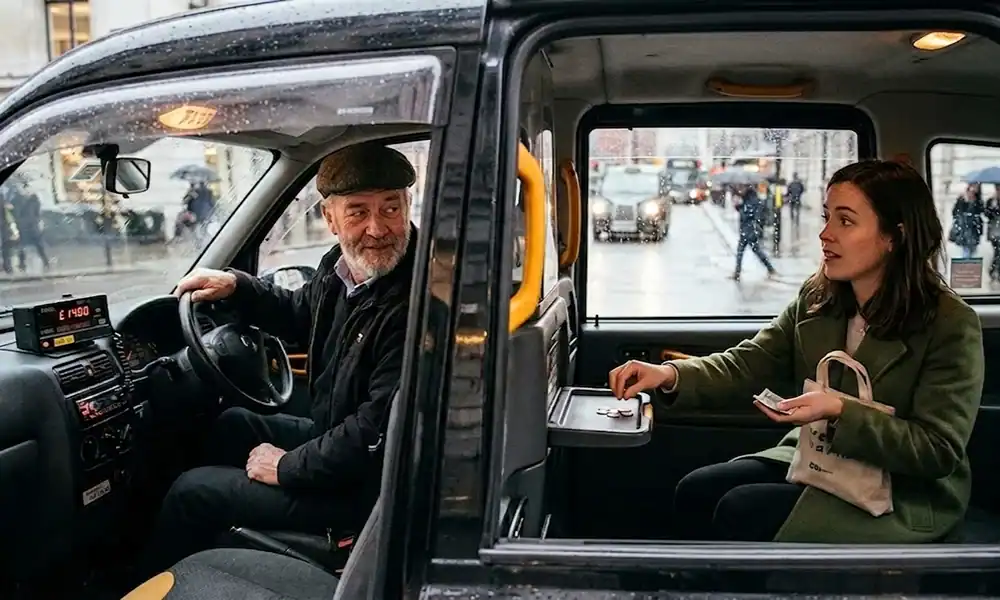
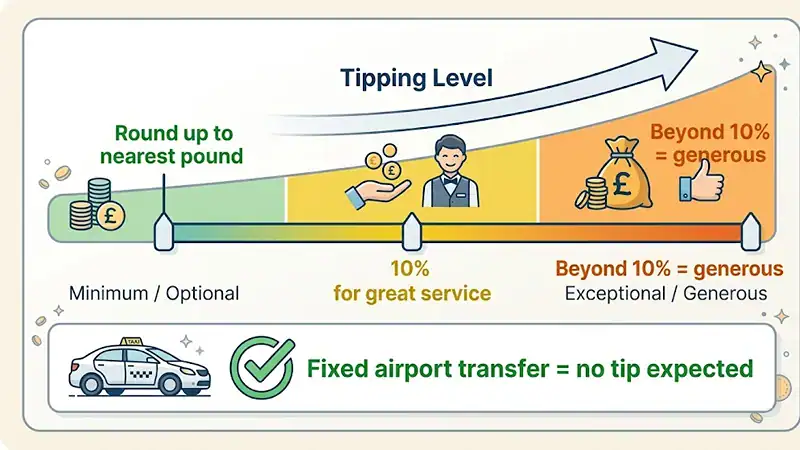
For a rough guide, rounding up to the nearest pound is the minimum, and around 10% is the usual upper end for good service. Anything beyond that is generous rather than customary. For a pre-booked airport transfer where the fare is fixed and agreed in advance, most passengers don’t tip at all; the driver has already been paid a fair, pre-arranged rate, and there’s no meter running up an “expected” percentage the way there might be with a metered city cab. If you’re booking with Ridex, you’ll know the cost upfront through our fixed-price Manchester airport taxi fares, so there’s no last-minute surprise on the meter and no pressure to tip to make up for one.
Cash, Card, or Neither
Card and contactless payments have made tipping slightly more visible than it used to be, since some card machines now prompt for a tip percentage before you pay. In the UK you can decline that prompt freely; saying “no tip” or entering £0 isn’t awkward or rude the way it might be elsewhere. For cash journeys, rounding up is still the simplest approach, and drivers rarely expect small change to be counted back.
Most UK taxi and private hire drivers are self-employed, so a tip normally goes straight to the person driving you. Where a driver is employed rather than self-employed, the Employment (Allocation of Tips) Act 2023 requires employers to pass on qualifying tips to workers in full.
Airport Transfers Are a Slightly Different Case
Pre-booked airport transfers, like the ones Ridex Taxis runs across Manchester and its connecting airports, work on fixed, agreed fares rather than a running meter. That changes the tipping calculation. Because the price is fixed and usually includes a set amount of waiting time, there’s no expectation to tip. If the driver goes out of their way, a small thank-you is warranted: helping load bags, tracking a delayed flight, adjusting the pickup time, or easing the stress of an early-morning departure. Having a fixed fare from the start also protects you from a separate problem: unlicensed or overpriced pickups at busy terminals. Before you accept a ride at an airport, it’s worth knowing the common airport taxi scams to watch for, so you can recognise a fair fare when you see one. A fixed, pre-agreed price is one of the easiest ways to avoid them entirely.
The Simple Rule of Thumb
If you’re unsure what to do, this covers almost every situation: round up for an ordinary journey, add a little more for standout service, and don’t feel obliged either way. UK taxi drivers are paid through the fare itself, not through tips, so whatever you add is appreciated but never assumed.
FAQ
Q1: Is tipping in taxis compulsory in the UK?
No. Not tipping isn’t considered rude in the UK, and there’s no need to feel awkward about it. The fare you’re charged is the full payment for the journey.
Q2: How much should you tip taxi drivers in the UK?
Rounding up to the nearest pound is normal. You may leave up to around 10% for excellent service, though you’re under no obligation to.
Q3: Do you tip black cab drivers and private hire drivers differently?
Slightly. Rounding up or adding around 10% is a more traditional habit with licensed black cabs, particularly in London. With minicabs and private hire journeys, tipping is more casual and many passengers don’t tip at all. App-based services such as Uber offer in-app tipping, but it’s entirely optional.
Q4: Am I supposed to tip for my pre-booked airport transfer?
There’s no need. The fare is agreed in advance, so a tip is purely a bonus for something extra, such as help with luggage or waiting on a delayed flight.
Q5: Do I need to tip on a long-distance taxi journey?
The same guidance applies as for short trips. Distance doesn’t change anything: round up if you like, or add a little more for good service.
Q6: Can I tip by card?
Yes. Many card machines and app bookings now offer a tip option, which you can decline without any awkwardness.



Leave a Comment
Your email address will not be published.