
Last checked against Manchester Airport and GOV.UK guidance in November 2026.
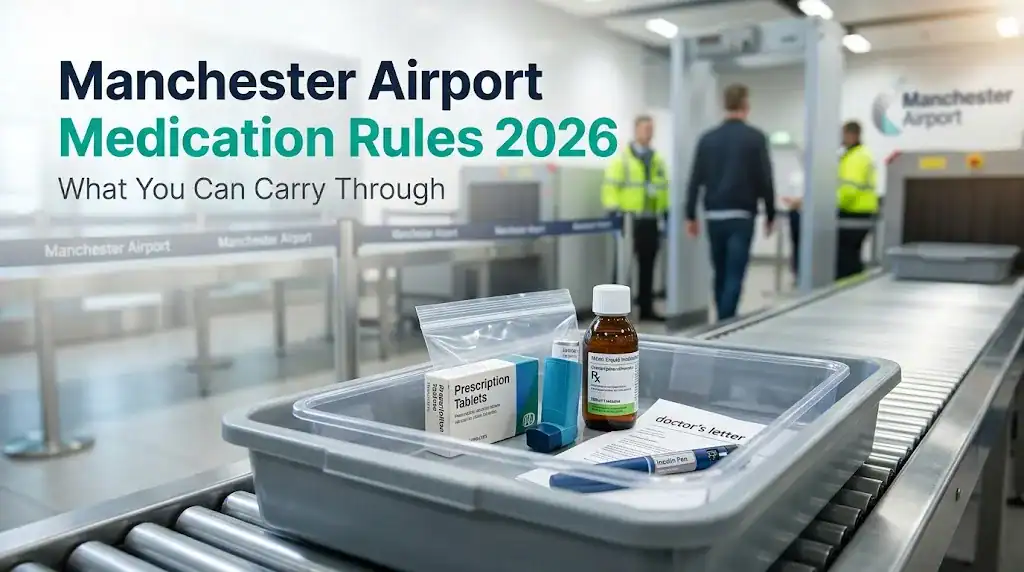
Under Manchester Airport medication rules, you can take tablets, inhalers and essential liquid medicines over 100ml through security at both Terminal 2 and Terminal 3. Ordinary tablets don’t need any paperwork. Liquid medicine in a container bigger than 100ml does, so pack a doctor’s letter, a prescription copy or the pharmacy label, and only bring what the journey needs.
So where does the muddle come from? Manchester has fitted CT scanners across its security lanes, which means liquids can now stay inside your bag, yet the 100ml liquid rule still covers everyday liquids as of November 2026. Heathrow and Birmingham have moved to two litres. Not Manchester, not yet. Medicine was never part of that cap anyway, provided you can show it’s yours.
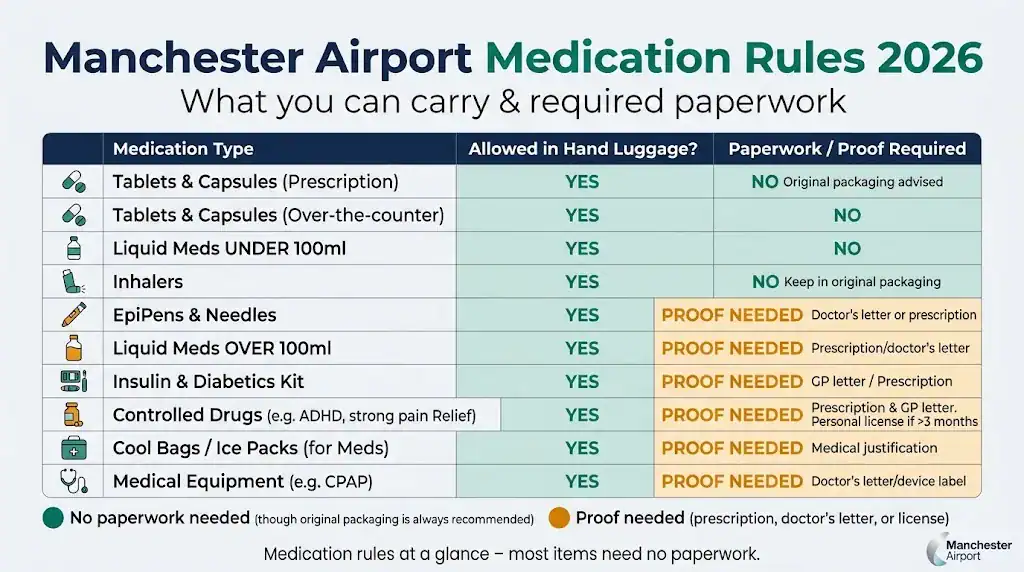
Manchester Airport Medication Rules at a Glance
Screenshot this before you set off, whether you’re getting the train or sitting in the back of a fixed price airport taxi. Everything in it comes from Manchester Airport’s own security page and the GOV.UK guidance behind it.
| What you’re packing | Allowed in hand luggage? | What you’ll need |
|---|---|---|
| Tablets and capsules | Yes | Nothing; the original box helps |
| Liquid medicine of 100ml or less | Yes, it can stay in your bag | Nothing |
| Liquid medicine over 100ml | Yes, enough for the journey | Doctor’s letter, prescription copy or pharmacy label |
| Inhalers | Yes | Nothing |
| Insulin pens, EpiPens and weight loss pens | Yes | Medical evidence for the needles |
| Cooling gel packs | Yes | Doctor’s letter confirming the medicine must stay cold |
| Insulin pump or CGM | Yes, worn on your body | Ask for a hand search instead of the scanner |
| CPAP or TENS machine | Yes, screened separately | Check your airline’s bag allowance |
| Medicines containing controlled drugs | Yes, and they must go in hand luggage | Prescription or a letter from your prescriber |
| Contact lens solution | Only up to 100ml | Not covered by the medicine exemption |
Spot what isn’t there? Nobody at security expects an NHS prescription for a strip of paracetamol. Paperwork really only comes into play for large liquids, needles, cold packs and controlled drugs.
Liquid Medicines Over 100ml
Most people landing on this page want one answer: can liquid medicine over 100ml get through? It can. Antibiotic suspension, liquid epilepsy treatments and prescribed nutrition drinks are all covered by the essential medicines exemption, whatever size the bottle is.
There’s a catch, though it has nothing to do with bottle size. You’re only allowed the amount your journey requires, according to Manchester Airport. Count the trip door to door, build in a sensible margin for delays, and let the hold take everything else. Use a lot of one liquid? Your pharmacist may be able to split it into two labelled bottles, one for the cabin and one for the suitcase.
Three things count as proof: a letter from your doctor, a copy of the prescription, or the printed pharmacy label on the box. Where people trip up, in practice, is decanting. They tip medicine into an unlabelled travel bottle to save space, then bin the original packaging and their proof along with it. Don’t be thrown if an officer opens a bottle to test it, either. That’s a routine check, nothing more.
What about the big bottle of Calpol or cough syrup you grabbed from Boots? Without a prescription, there’s nothing to prove, so pick up a 100ml bottle for your cabin bag and let the large one travel in the hold. For toiletries, drinks and everything else, our guide to the current liquid rules at Manchester Airport covers the detail.
Inhalers, Insulin and Injections
Taking inhalers through security is the easy bit. Technically they’re listed as liquids at Manchester, but they fall under the medicine exemption, so keep your reliever where you can grab it and stop worrying.
Needles need a little more thought. Hypodermic syringes sit on the airport’s prohibited list unless medical evidence backs them up, which is why the pharmacy label with your name on it should stay on your insulin pens, EpiPen or injection pens. Clinic letters do the same job. Weight loss pens like Mounjaro and Wegovy get treated no differently, and a label from a private online pharmacy carries just as much weight as an NHS one.
Got medicine that has to stay cold? Cooling gel packs are allowed, though Manchester asks for a doctor’s letter saying the medicine needs chilling. Loose ice packs are a greyer area. GOV.UK’s only advice on them is to contact the airport first, so a proper medical cool bag with gel packs tends to be far less hassle.
Insulin pumps and glucose monitors
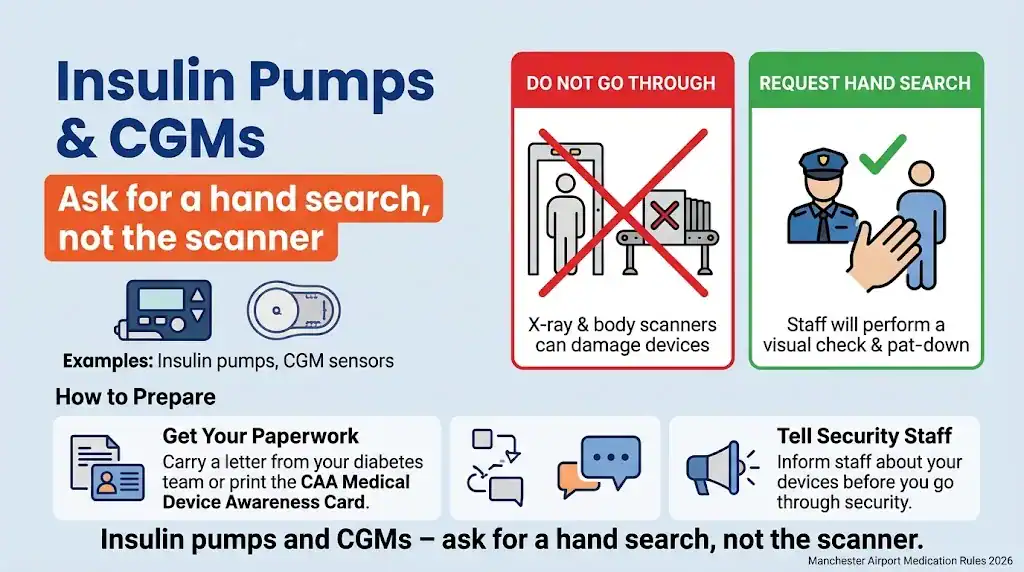
Anyone wearing an insulin pump, or a CGM such as a Libre or Dexcom, should know where they stand before joining the queue. According to the Civil Aviation Authority, you shouldn’t be asked to take a medical device off for screening, and pumps and CGMs shouldn’t pass through either the body scanner or the bag scanner. Mention it to the officer before stepping forward. The usual alternative is a hand search, which you can ask to have in a private room with a companion.
Printing the CAA’s Medical Device Awareness Card, or carrying a short letter from your diabetes team, saves a lot of back and forth with an officer who isn’t sure. Prefer extra support from check in to the gate? Ask your airline to book special assistance at Manchester Airport at least 48 hours before you fly.
Prescriptions and Doctor’s Letters
How often do you actually need a doctor’s letter for flying? Less than the forums would have you believe. Realistically, a letter helps in three cases: needles that aren’t in labelled packaging, gel packs for medicine and, most of all, controlled drugs.
Prescription medication in hand luggage is usually straightforward. Controlled drugs are the exception, and the list is longer than most people expect: codeine, tramadol, diazepam, pregabalin, gabapentin and stimulant ADHD medication such as methylphenidate are all controlled in the UK. This kind of medicine has to travel in your hand luggage whenever you leave or come back into the country, GOV.UK says, and you’ll need to prove it was prescribed to you. Ideally, the letter shows your name, each medicine with its dose and strength, your travel dates, and the prescriber’s signature and registration details. Leave a few weeks to get one sorted, and expect many surgeries to charge.
Travelling with medication abroad adds one more layer that no UK airport can sort for you: the law at your destination. Japan and the UAE, to give two examples, restrict certain medicines that are routine on an NHS prescription. Checking with your destination’s embassy before you fly is the safest bet. Heading off for months rather than weeks? Get in touch with the Home Office’s Drug and Firearms Licensing Unit first.
Medication in Hold Luggage
Packing medicine in your suitcase is allowed. Tablets, liquid medicines, syringes, inhalers, gel packs and medical equipment can all go in the hold. Whether you should is a different question, and it mostly comes down to how you’d manage if your case flew to Lisbon while you landed in Lanzarote.
Our own rule of thumb is simple enough. Anything you couldn’t replace within 48 hours stays with you. Insulin belongs in the cabin, since the hold can get cold enough to freeze it, and controlled drugs have to be in hand luggage regardless.
Going Through Security at Terminal 2 and Terminal 3
Terminal 1 has shut for good, which leaves two buildings. Ryanair passengers use Terminal 3. Pretty much everyone else, Jet2, easyJet and Emirates included, departs from the rebuilt Terminal 2. Whichever one you’re in, Manchester Airport security applies the same medicine rules.
Some quick prep makes the queue painless:
- Keep medicines, labels and letters together in one clear pouch near the top of your cabin bag.
- Tell the security officer about any liquid medicine over 100ml, needles or cool packs before your bag goes through, and give a CPAP machine its own tray.
- Flag a pump or CGM before the body scanner rather than after.
- Expect a swab, or a bottle being opened and tested. Completely routine.
Living with a hidden condition? The Hidden Disabilities Sunflower lanyard can make the whole thing calmer. Pick one up from the Assistance Reception in the Terminal 2 or Terminal 3 check in hall. Wearing it, Manchester says, gets you into any security lane, the Family and Assisted Travel lane included.
Truthfully, ten minutes of packing the night before covers most of this. Labels on. Letters printed. Cool bag ready. Should Manchester get approval for two litres, the general liquid limit will rise, so check the airport’s security page during the week you fly; the medicine exemption doesn’t hinge on it either way.
Riding to the airport with us? Mention any medical kit when you book, whether that’s space for a CPAP case or a drop off right by your terminal, and we’ll plan around it. Far better than fretting about it on the M56.
Frequently Asked Questions
Do I need a prescription to take tablets through Manchester Airport?
Not unless they contain a controlled drug. Everyday tablets and capsules go through Manchester Airport security with no paperwork at all. It still makes sense to keep them in their original boxes, since that answers any questions quickly and some countries check medicines when you land.
Can I take Mounjaro or Wegovy pens in my hand luggage?
Yes, you can. Security treats weight loss pens like any other injectable medicine, so they’re fine as long as there’s medical evidence for the needles. Your pharmacy label from an online or high street prescription normally covers that. Using gel packs too? Bring a letter confirming the pens need to stay cold.
What if I’ve forgotten my doctor’s letter?
Look at the pharmacy label first, as it might be all the proof you need. Printed prescription labels are accepted at Manchester as proof for liquid medicine over 100ml. With neither a label nor a letter, a big bottle could be turned away at security, so carrying a smaller bottle in the cabin and the rest in the hold is the safer move.
Is Manchester Airport changing the 100ml liquid rule?
Nothing has changed yet. In November 2026, Manchester still caps everyday liquids at 100ml per container, even though the CT scanners mean you can leave them in your bag. Each airport needs government approval before moving to two litres. Essential medicine has never been bound by the 100ml cap, and that exemption isn’t tied to any change.




Leave a Comment
Your email address will not be published.