
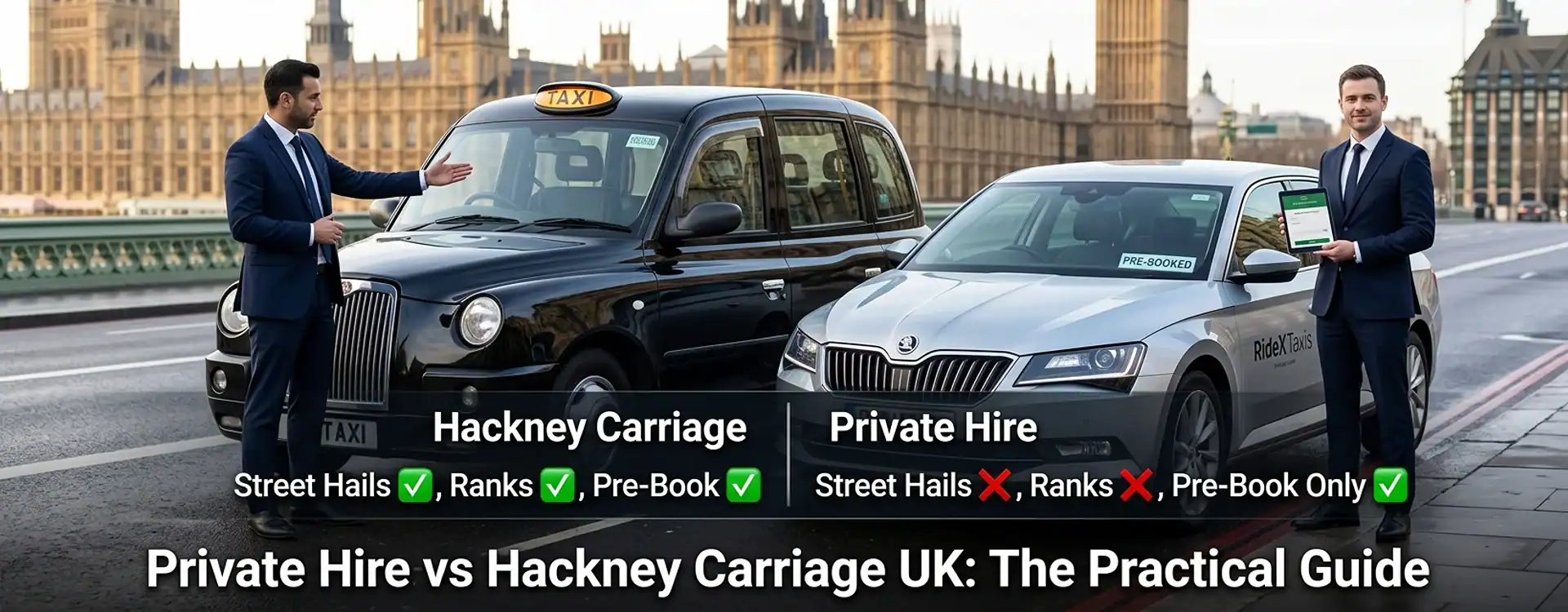
The difference between a private hire vehicle and a hackney carriage comes down to how you hire it. In England and Wales, a hackney carriage (taxi) can accept pre-bookings, pick up street hails, and use ranks within its licensed area, known legally as “plying for hire”. A private hire vehicle (often called a minicab) must be booked through a licensed operator. A pre-booked private hire airport transfer is a typical example. It cannot pick up street hails.
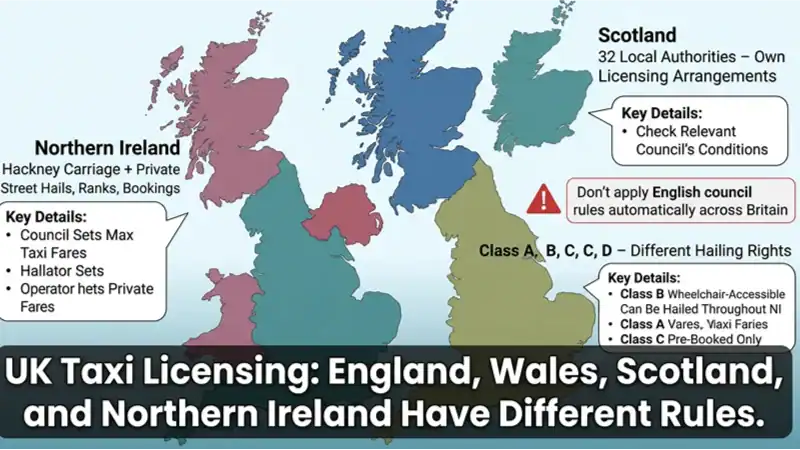
Northern Ireland divides taxis into Classes A, B, C and D, while Scotland has its own licensing legislation. Rules set by an English council don’t automatically apply elsewhere in the UK.
Private Hire vs Hackney Carriage Comparison Table
The table summarises the standard England-and-Wales distinction. Local licensing conditions also apply.
| Feature | Hackney carriage | Private hire vehicle | What to check |
|---|---|---|---|
| Street hails | Permitted within its licensed area | Not permitted | Is it licensed to accept your hail here? |
| Taxi ranks | Can use authorised ranks | Cannot accept rank hires | Don’t treat a parked minicab as a rank taxi. |
| Bookings | Allowed | Required through a licensed operator | Keep the booking confirmation. |
| Fare controls | Council maximum tariffs commonly apply. | The operator sets prices. | Ask about extras before travelling. |
| Vehicle appearance | Local requirements vary. | Local requirements vary. | Check the licence plate and driver badge, not just the colour. |
| Journey destination | Can travel beyond its licensing boundary | Can undertake booked out-of-area journeys | Destination and pickup rights are different. |
The booking and fare distinctions are supported by government licensing guidance and council passenger guidance.
What does “hackney carriage” mean?
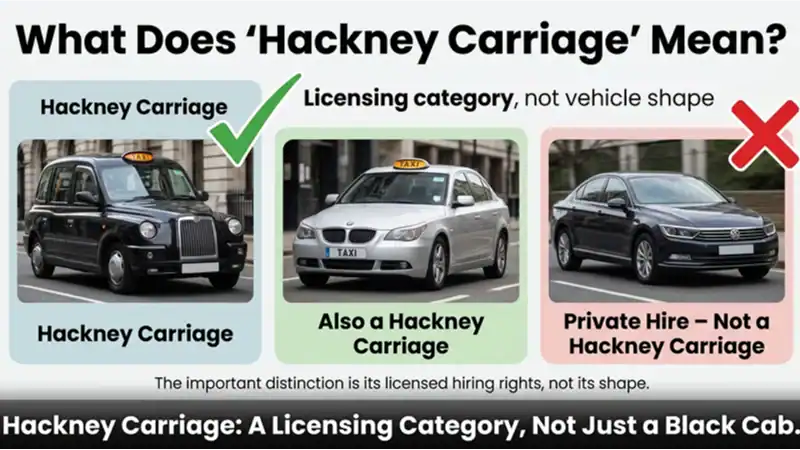
It’s the formal licensing term commonly used for a taxi in England and Wales. It doesn’t mean every vehicle must look like a London black cab – what matters is its licensed hiring rights, not its shape. Private hire vehicles are often called minicabs, but they must be licensed too. In London, the terms used are simply “taxi” and “private hire vehicle”, and both are licensed by Transport for London (TfL).
Booking, fares, and national differences
Pre-booked doesn’t necessarily mean booked hours ahead
A private hire journey, such as a Manchester Airport transfer, can be arranged through an operator’s app, website or phone line. The essential requirement is that the operator takes the booking before the journey; simply approaching an available driver isn’t the same.
A car arriving quickly after an app booking can therefore be legitimate private hire. A driver offering an unrecorded cash journey outside that process is a different situation. Operators can also pass a booking to another licensed operator, so the car that arrives may display a plate from a different council.
Neither category is automatically cheaper
In England and Wales, councils can set maximum hackney carriage fares for journeys within their area, but they cannot set private hire fares. If a hackney carriage journey ends outside its licensing area, the driver can’t charge more than the meter fare unless a different fare was agreed before the journey started. Check the total fare, including any waiting, parking, airport and cancellation charges – a low headline quote is only useful if you know what it covers. For a wider view of pricing, see our guide on UK taxi fares in 2026.
Scotland and Northern Ireland need separate checks
Scotland has a separate regime: its 32 local authorities license taxis and private hire cars under the Civic Government (Scotland) Act 1982. Check the relevant council’s conditions rather than relying on guidance written for an English district.
Northern Ireland’s categories differ more substantially. Class B wheelchair-accessible taxis can be hailed anywhere in Northern Ireland. Class A taxis can be hailed at any time outside the Belfast Zone, but inside it only from midnight to 6am on Friday and Saturday nights and around public holidays. Class C vehicles, such as chauffeur, wedding and funeral cars, are pre-booked only, while Class D taxis run on set routes and can charge passengers separate fares.
Licensing rules are changing
As of October 2026, the UK Government is developing national licensing standards for taxis and private hire vehicles in England and has announced a draft Taxi and Private Hire Vehicle Bill. Wales has proposed its own reforms, but no Bill was included in the Welsh Government’s July 2026 legislative programme. Until any changes take effect, the current rules described here still apply.
How to choose and book the right service in 3 steps
1. Select the service that suits your pickup
To travel immediately, use an official taxi rank or hail a hackney carriage licensed for that area. For a planned transfer, you can pre-book either category. Some people assume a private hire car with taxi-company branding can take an unbooked trip, but branding does not override the booking rules.
2. Confirm the fare basis
Ask whether the price is fixed, an estimate or a metered fare. Confirm any waiting, parking and airport pickup charges beforehand. With private hire, you pay the operator’s quoted price under its terms rather than making a separate arrangement with the driver. Keep the confirmation as a record in case of a dispute.
3. Check the vehicle and any support you need
Match the arriving vehicle to your booking and check its licensing identification. If you use a wheelchair or need help finding the car, say so when booking. Don’t assume every taxi is wheelchair accessible. Councils publish lists of wheelchair-accessible vehicles, and giving advance notice helps the driver provide the right assistance.
Practical checks that are easy to miss
- A taxi may take you outside its licensing area, but that doesn’t give it the right to pick up street hails there.
- A private hire vehicle that picks up a passenger without a booking may not be insured for that journey.
- Look for the council licence plate and the driver’s ID badge. Private hire vehicles often display a “pre-booked only” sign rather than a roof light.
- If you use a wheelchair, say whether you’ll stay seated in it during the journey and confirm which vehicle will be sent.
- Keep the operator’s name, booking reference and receipt together – it makes the booking and agreed price easier to identify.
FAQs
What are the differences between hackney carriage and private hire?
The key distinction is how the passenger hires the vehicle. A taxi can accept street and rank hires as well as bookings. A private hire vehicle must be booked through a licensed operator. Both categories are licensed; private hire does not mean an unregulated service.
Are private hire vehicles allowed to be hailed?
No. In England and Wales, a private hire vehicle must be booked through a licensed operator before the journey. That requirement doesn’t go away because a car looks available, has company branding or the driver is willing to take cash. Use the operator’s booking channel and don’t arrange an informal pickup with the driver. Private hire cars in Scotland and Class C vehicles in Northern Ireland are also pre-booked only.
Is it possible to book a hackney carriage in advance?
Yes. As well as being hailed in the street, hackney carriages can take advance bookings, so they’re an option for planned journeys too. When booking, confirm the collection arrangements and the fare basis, particularly if the destination is outside the vehicle’s licensing area.
Are private hires cheaper than taxis?
Not necessarily. Compare quotes for the same journey and departure time, and check whether waiting or airport charges are included. The vehicle’s licensing category alone doesn’t guarantee a saving.
Is Uber a taxi or private hire?
Most app-based ride-hailing services in the UK, including Uber and Bolt, operate as licensed private hire operators. The car must be booked through the app – the driver can’t pick you up on the street without a booking. Some apps also let you book licensed taxis in certain cities, so check the vehicle type shown before you confirm.
Are all hackney carriages black cabs?
No. “Hackney carriage” describes a licensing category rather than one universal vehicle design. Don’t use black paint, vehicle shape or an app listing as proof of hiring rights. Check the vehicle’s local licensing identification and the relevant council’s guidance on recognising taxis and private hire vehicles.
Can a taxi take me outside its council area?
Yes. Crossing the licensing boundary as part of a journey is different from accepting a new street hail there. Government guidance also recognises that licensed taxis can carry pre-booked fares anywhere in England and Wales. Check the fare before departure, because an out-of-area journey may have a different agreed charge.
Can either service refuse an assistance dog?
Generally, no. Under the Equality Act 2010, taxi and private hire drivers in Great Britain must carry assistance dogs at no extra charge unless they hold a medical exemption certificate from their licensing authority. Private hire operators must not refuse a booking, and drivers must not refuse to carry out a booking, because of an assistance dog. Northern Ireland has equivalent duties under the Disability Discrimination Act 1995. Report a suspected unlawful refusal to the relevant licensing authority with the booking details.
What to do before your next journey
For private hire vs hackney carriage, start with the pickup method, then check price and suitability. Consult GOV.UK’s taxi and private hire licensing page. Check your council’s licensing pages. Read Northern Ireland’s taxi-class guidance.



Leave a Comment
Your email address will not be published.